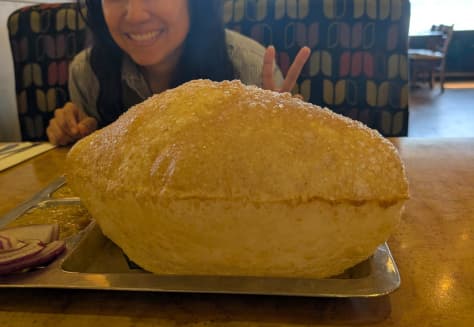
The face of someone who has 500 saved recipes and has cooked maybe 30 of them.
Blog
You Save Every Recipe You See. So Why Aren't You Cooking?
You have 347 saved recipes on Instagram. 84 TikToks bookmarked. A Pinterest board called "actually going to make these" that you have not touched since 2022.
Tonight, you ordered DoorDash.
Here's the thing: you're not lazy. You may be part of the most food-obsessed generation alive — one that spends more on food than any before it, and genuinely wants to be in the kitchen more than it is.
So what's standing in the way? It's not just the recipe that assumes you already know what "fold gently" or "reduce until thickened" actually means. Nor the ingredient list that sends you to three different stores for two items you'll use once. The seemingly easy job of turning a 60-second TikTok into a grocery list, a grocery list into a plan, and a plan into an actual meal on an actual Tuesday night morphs into a thousand little frictions that stop you in your tracks.
Let's set the record straight on something.
Gen Z gets a lot of grief about not knowing how to cook. The egg videos, the "I burned water" confessions. The general narrative is that this is a generation raised on DoorDash and defeated by a stovetop.
Yet the data tells a completely different story.
Gen Z spends more money on food than any other generation alive — averaging nearly $20,000 a year on meals, ingredients, and dining out. They cook more adventurously than their parents, eat a wider variety of cuisines, and cook for their friends at least three times more often than Gen X does. More than half — 51% — say they actually like or love meal prep.¹
This is the most food-curious generation in modern history, growing up watching cooking become culture. Food isn't just sustenance for them — it's identity, community, creativity, and one of the few areas of life where spending $40 on a nice dinner still feels like a reasonable act of joy in an otherwise expensive world.
The scroll-to-stove problem
Unfortunately, that same survey that says Gen Z loves cooking also found that 80% of them don't cook as often as they want to.¹ Eight out of ten people who want to be in the kitchen — aren't. And when asked why, they weren't reaching for excuses. They pointed straight at confidence. Not knowing enough. Feeling unable to recreate the beautiful dish seen in a 30-second video on TikTok, barely even understanding anything said about the preparation.
That problem has a name, and it's called the scroll-to-stove problem. And it's bigger than anyone wants to admit.
The people who save the most recipes aren't the ones who don't care about cooking but the ones who care the most. They're the ones who see a dish and feel something — not just hunger, but inspiration. The pull to create it, to understand it, to visualize themselves standing in a kitchen and making something with their hands that an hour ago only existed on a screen.
That feeling is real. It's the same feeling that drives every great home cook — the spark that says I want to make that.
Think about the last time you actually followed through on a recipe you saved. Really think about it. You had to remember you saved it. Find it again among the 300 other things you saved. Check if you had the ingredients — you didn't, fully. Decide whether the substitution would work — you weren't sure. Figure out the order of operations the recipe barely explained. Carve out the time. Protect that time. And somewhere in that chain, most people quietly give up and order something instead.
The desire to cook is already there. What's missing isn't motivation — it's the bridge between feeling inspired and actually being the person standing at the stove, apron on, knife in hand, doing the cooking.
From the inside
Speaking from experience, I have somewhere north of 500 saved recipes across my phone right now. Videos, bookmarks, screenshots, links buried in notes apps. A genuine archive of culinary ambition.
I've cooked maybe 30 of them, and I feel this problem as deeply as anyone reading this.
It was never about the content. The problem is what happens trying to actually recreate it.
You're in a 5x10 kitchen with one functioning burner, a cutting board the size of a magazine, and a drawer full of utensils you inherited and can't identify. The recipe says "sear on high heat" but your smoke detector is eight feet away and has strong opinions. You mis-read the steps, added the garlic too early, and now you're three minutes behind. The recipe assumed you had room to adjust on the fly, but you don't. So, now what?
The 47-second video is genuinely life-changing for 47 seconds. Awe-inspiring, even. What it can't do is follow you home. It can't account for the layout of your specific chaos, the tools you actually own, or the moment midway through a recipe where you genuinely don't know if you're on step four or step six and everything on the stove is at a critical point simultaneously.
TikTok built the appetite. It just didn't build the on-ramp.
The creator's blind spot
Just like the home cooks, the creators run into blind spots in their "studio kitchen." But instead of fumbling through a recipe, they fumble through what happens once their content has been released to the masses.
They know how many people saved the video, the view count, likes, and the shares. The dopamine rush of their save counts going up just leads them to make more beautifully inspiring content, with more "dumbed down" steps, and straying further and further from the practical reality of the people watching it.²
Two audiences, a broken system, and the same question neither of them can answer yet: what actually happens after the save?
What comes next
No one is going to make you cook. Not even your mom.
But here's what we believe: you don't need a lecture, a meal plan, or another recipe app with a better search filter. You need something that gets you into the kitchen with a recipe in mind and makes the attempt itself feel like the goal — whether the dish turns out perfect or completely sideways. Because the cook who burns the garlic and tries again next week is infinitely closer to where they want to be than the one still scrolling at 9pm.
That's step one. Get in the kitchen. See what happens. Go from there.
We're building something around exactly that idea — something that makes the attempt the point, not just the outcome. We're not ready to show you everything yet. But we're close.
If this piece put words to something you've felt for a while, we'd love for you to be the first to know when we are.
Lauren D. is a co-founder of Saltpig. She has 500+ saved recipes and has cooked about 30 of them. She's working on fixing that.
Sources
-
Current Backyard / Pollfish Survey, February & May 2025 — Gen Z food spend, cooking frequency, and aspiration gap data. Via The National Provisioner and GlobeNewswire and FMI.org
-
Statista, September 2024 — 70% of Gen Z identify TikTok as their top food discovery platform. Via Plastic Container City
-
Home Run Inn Pizza Survey, 2023 — Gen Z cooking confidence gap and decline of home economics education. Via HomeRunInnPizza.com
Keep reading
- ·4 min read
The Streak That Rewired My Cravings
14 weeks into my Saltpig cook streak, I'm baking Jimmy John's bread and making mooncakes from scratch. Is a streak building a real habit, or am I just hooked on not breaking it?
- ·3 min read
"It Looked Good, So I Wanted to Make It": It Wasn't Confidence for Them. It Was Something Else Entirely.
They blame confidence. But watching my Gen Z crew tackle dishes they'd never made showed me the real gap between me and them is gauging difficulty, not nerve.